
 fino a 12 rate
 fino a 3 rate
 fino a 4 rate
 carte e bonifico
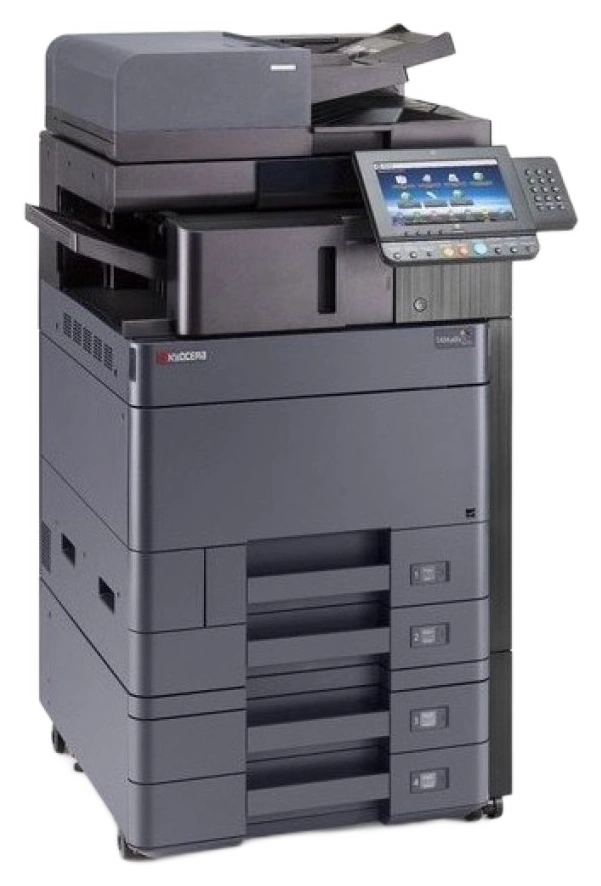
Kyocera TASKalfa 2553ci
The model at a glance
The Kyocera TASKalfa 2553ci is a professional A3/SRA3 colour laser multifunction printer recommended for businesses, offices, professional practices, schools, public authorities, administrative departments and workgroups that need reliable printing, copying and scanning with low running costs.
It is particularly suitable for business documents, invoices, contracts, quotations, presentations, charts, tables, files, product sheets and internal sales materials. It can also produce brochures and light graphics thanks to its high resolution and SRA3 handling, but Kyocera should primarily be recommended for document printing, reliability and long-lasting components. Compared with Xerox, Ricoh and Konica Minolta, it is less specialised in professional graphics, but generally offers lower maintenance costs and components designed to last for up to several hundred thousand pages.
Print speed: up to 25 pages per minute in A4 and up to 12 pages per minute in A3, both in colour and black and white. It also maintains up to 25 pages per minute when printing A4 in duplex.
Functions: printing, copying, colour scanning and digital sending to email, network folders, FTP, USB and document boxes. Fax is optional via Fax System 12 and must be verified for each individual configuration.
Duplex: integrated automatic duplex for printing and copying. Duplex scanning depends on the installed document feeder: it can use a reversing RADF or a single-pass duplex feeder that captures both sides of the sheet in one pass.
Print resolution: up to 1,200 × 1,200 dpi, with equivalent quality up to 4,800 × 1,200 dpi. Suitable for crisp text, professional documents, logos, charts, tables, corporate images, presentations and light graphics.
Supported formats: A6, A5, A4, A3, SRA3, envelopes and custom sizes. It also supports banner printing up to approximately 1,200 mm. SRA3 allows brochures, flyers and covers to be produced with bleed for trimming.
Supported paper weights: approximately 52 to 300 g/m² from the cassettes and multipurpose tray, depending on the format and configuration. Automatic duplex supports weights up to approximately 256 g/m². It handles plain, letterhead and recycled paper, compatible coated paper, glossy paper, labels, envelopes and cardstock. Although it supports up to 300 g/m², Xerox is generally more suitable for frequent graphic production on heavy media.
ADF: compatible with various document feeders. Simpler configurations have a 50- or 140-sheet RADF, while the DP-7110 and DP-7130 single-pass duplex feeders hold up to 270 sheets and reach approximately 180 images per minute in duplex. Actual speed depends on the installed document processor.
Connectivity: Gigabit Ethernet, USB, USB host ports, NFC and mobile printing via Apple AirPrint, Mopria and Kyocera Mobile Print. Wi-Fi and Wi-Fi Direct are available via an optional interface.
Work volumes: suitable for medium-volume offices. The stated maximum duty cycle is approximately 100,000 pages per month, but for continuous use it is preferable to keep regular volumes significantly lower.
Main consumables: Kyocera TK-8345K black toner with an approximate yield of up to 20,000 pages; TK-8345C cyan, TK-8345M magenta and TK-8345Y yellow toner with an approximate yield of up to 12,000 pages per colour. Yields are calculated at 5% A4 coverage and may vary depending on the documents printed.
Maintenance components: Kyocera WT-8500 waste toner box with an approximate life of up to 40,000 pages. The platform maintenance kit is MK-8335: components listed as MK-8335 A/B have an approximate life of 200,000 pages, while some long-life MK-8335 D/E components can reach approximately 600,000 pages. This long life of the drums, developers and internal components is one of the main advantages of Kyocera multifunction printers and helps reduce replacements and maintenance costs.
Recommended use: businesses, administrative offices, professional practices, schools and public authorities looking for a reliable A3/SRA3 colour multifunction printer for documents, invoices, contracts, presentations, charts, files and sales materials. It should primarily be recommended to customers who prioritise machine durability, low maintenance costs and document printing. It can handle light graphics and cardstock up to 300 g/m², but Xerox, Ricoh or Konica Minolta are preferable for professional graphic quality, photographs and frequent use of heavy media.